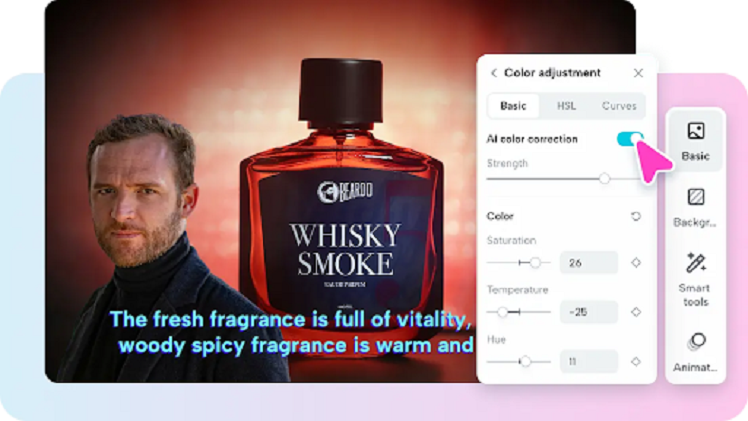
The audio of a video can affect the tone, clarity, credibility, and viewing experience. Strong narration supports the audience in understanding the messages and supports the establishment of a recognizable content identity. Now, creating, translating, and syncing voiceover for different video formats is simplified by AI. These capabilities are brought to Pippit’s AI-driven creative process for marketing and video production.
What Makes a Voiceover Feel Personalized?
A custom voiceover has been carefully selected for tone, pace, pitch, pronunciation, emphasis, and delivery. AI dubbing can be used to generate alternative narration without compromising the video’s tone and communication style. A soothing tone can enhance instructional videos, and a more enthusiastic delivery can help you boost your promotional material. The voice of each video should be appropriate for the audience, the subject, the platform, and the purpose of the video. While generic narration is good for getting the message across, customised narration can make for greater recognition. Consistency is also important for creating repeatable lessons, ads, demos, or social content. Pippit offers voice services that enable creators to tailor narration to the video’s needs. By carefully selecting pronunciation and pacing, generated speech can be more intelligible and more natural-sounding.
AI Dubbing as a Voiceover Creation Method
AI dubbing can substitute for spoken audio and adjust narration to the video’s existing time constraints. Modern systems can synthesize speech from a script and synchronize speech and visual sequences. SeedAudio 2.0 can also be integrated into larger AI video projects, such as video scene generation and narration. Script generation, captioning, translation, and synchronized speech are examples of supporting capabilities. Pippit can produce multilingual versions without the need for a full manual recording. Creators can experiment with various voices without altering the video’s structure. This can help minimize repetitive production efforts for tutorials, product videos, and explainers. But even then, generated speech should be carefully checked before it is published.
Exploring Custom Voice Options Responsibly
Built-in AI voices are convenient options, whereas custom voices are more identity-specific and consistent. Custom voices can be used with voice recordings of your own voice, if available. Permission is always important when a voice model is a representation of the speech of another identifiable person. Do not make or use a voice model without prior consent of the owner. The responsible use of voice helps ensure the safety of creators, audiences, brands, and people depicted in digital content. Regular education, promotion, and branding communication can be addressed by custom voices. Audiences can also pick up that there’s a video on a similar subject if the pronunciation is uniform. Pippit allows you to customize the voice as well as edit and generate video.
Steps to Create Personalized Voiceovers With AI Dubbing and Custom Voice Options
Step 1: Build Your Custom Voiceover Project
- Sign up for Pippit with Google, TikTok, or Facebook.
- Open “More” and select “Video generator”.
- Select an AI model, such as Dreamina Seedance 1.0, Dreamina Seedance 2.0, Dreamina Seedance 2.0 Fast, Dreamina Seedance 2.0 Mini, or Dreamina Seedance 2.5.
- Add a detailed prompt with your desired details, angles, text, and dubbing script.
- Choose the video length, language, subtitles, and aspect ratio.
- Click “+” to upload reference images or videos from your device, phone, Dropbox, or a link. You can also select assets.
- Click “Generate”.
Step 2: Generate the Personalized Voiceover Video
- After “Generate”, Pippit creates the video based on your prompt and reference media.
- AI manages transitions, pacing, captions, avatars, voice, lyrics, and visual enhancements.
- Review the video draft.
Step 3: Fine-Tune Your Voiceover and Export
- Use “Download” to save it, “Regenerate” for another version, or “Edit more” to customize it.
- Edit captions and text, and adjust size, color, alignment, filters, and effects.
- Add background music, remove backgrounds, and fine-tune visuals.
- Click “Export”.
- Select “Publish” for TikTok, Instagram, or Facebook, or “Download” with your preferred format, resolution, frame rate, and quality.
Matching Voice Characteristics to Different Video Formats
The type of video dictates the kind of narration that should be used to keep the video clear and interesting to the audience. A confident product demonstration explains the features without overwhelming viewers. For some, a fast tempo is more appropriate to complement the benefits and messaging that is simple. Explainers and tutorials should be clearly pronounced, have a controlled pace, and emphasize the appropriate points. A comfortable pace for educational videos allows learners sufficient time to process. Expressive delivery can be used to grab attention, especially in short-form social videos. Course creators can keep a consistent voice throughout the course for continuity. Pippit’s voice and editing workflow are helpful for adapting narration along with the visual presentation.
Refining Personalized Voiceovers After Generation
Post-generation review is still important as automated narration can have subtle quality problems. Pay close attention to any unusual pauses, pacing, repetition of words, or pronunciation. Review and compare all captions to the audio for accuracy and timing. When narration changes, make sure to tune in the visuals accordingly to keep the scenes on beat. Pippit offers editing features to trim, split, resize, reframe, add backgrounds, apply filters, transitions, and visual enhancements. When the generated result is not in the direction you intended, regenerate sections. By making a few changes, you can make it better rhythm without making an entirely new video. AI MV should balance the background music to make the narration easy to understand.
Where Custom AI Voiceovers Can Be Useful
AI voices can help with a wide range of content production needs with custom and selectable options:
- Product creators can create familiar narration for demonstration and feature explanations.
- Teachers can ensure uniformity of voice within lessons and in instructional materials.
- Using appropriate language and voice options, businesses can create multilingual variants.
- Social creators can experiment with different styles of narration for repeatable content formats.
- Course creators can maintain consistent vocal attributes throughout teaching videos.
Pippit can assist with these workflows through the integration of voice creation and video editing and generation. Multilingual production can also be used to adjust already created content for audiences using other languages. The same voice style can be used to help with recognition without having to manually record several times.
Conclusion
Creative voice customization provides flexibility across today’s video production workflows. Considerate use of voice can enhance consistency, clarity, pacing, and audience recognition. Multilingual production and alternative narration can also be made easier through AI-assisted dubbing without having to rebuild each individual video—voice, dubbing, generation, captions, and editing all in one streamlined creative workflow with Pippit. But responsible use of voice is still necessary, particularly if the voice is custom-made and is actually someone else. Correct script, pacing, editing, and final review enhance the final product. AI-generated videos can appear coherent, purposeful, and uniquely targeted to their viewers, with careful customization.